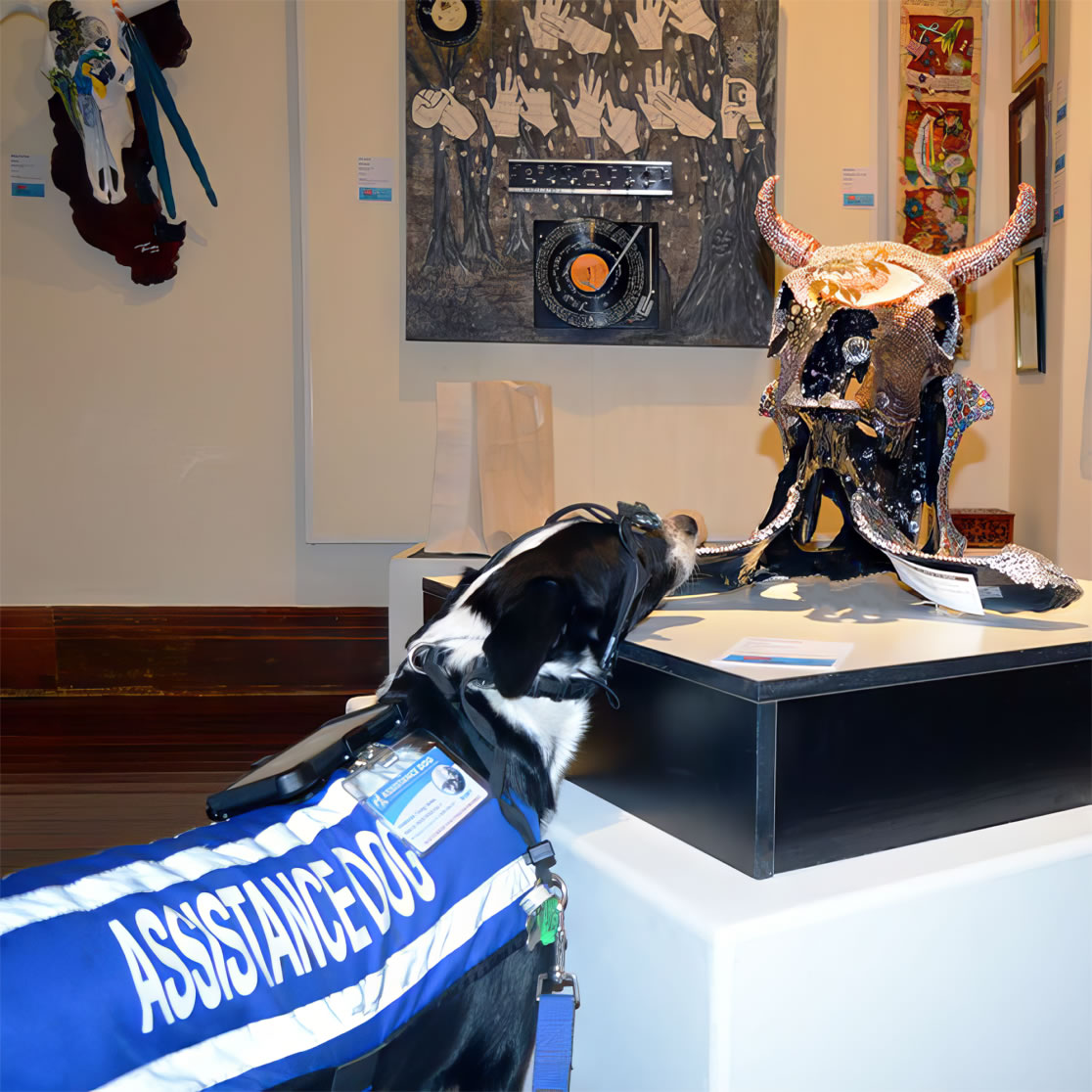
And say Ruby responds
Lucan, a Roman poet of the 1st century AD, depicted dogs in his epic poem “Pharsalia” as mere reactive machines, devoid of agency or emotion. In his work, Lucan portrays dogs as instruments of war, obedient to their masters’ commands and driven solely by instinct and training rather than independent thought or feeling. This portrayal reflects the prevailing Stoic philosophy of the time, which emphasized rationality and control over emotion, viewing animals as inferior beings lacking in reason.
Medium
Digital photograph
Image type
Digital C-Type print, flush-mounted on 3mm Alupanel
Dimensions
150 x 150 x 3 mm
Critical context
Derrida coined the title “And Say the Animal Responded” for his 1997 lecture, where he delved into the philosophical debate surrounding the perception of ‘the animal’ as merely capable of mechanical reactions. Expanding on this in his subsequent lecture, “The Animal That Therefore I Am,” Derrida acknowledged that animals could actively return human gazes. Inspired by his cat muse, he realized animals were sentient beings, challenging Lucan’s view of them as mere reactive machines (Derrida & Wills 2002, 2008).
Nevertheless, Derrida did not extensively ponder a more profound interaction involving a deeper understanding and recognition of animals’ ability to reciprocate. My work builds on Derrida’s initial explorations, incorporating scientific, biological, artistic, and disability philosophical perspectives as an observational and lived interaction – what I now term as ‘trans-species collaboration’.
Ruby,a PTSD Service dog of 10 years, adeptly navigating human social and cultural nuances to assist me navigate mine. And Ruby responds to that!….
Citations:
Derrida, Jacques, and Wills, David. 2002. “The Animal That Therefore I Am (More to Follow).” Critical Inquiry 28, no. 2 369–418. http://www.jstor.org/stable/1344276.
Derrida, Jacques, and Wills, David. 2008. “And Say the Animal Responded?” In The Animal That Therefore I Am, edited by Marie-Louise Mallet, 119–40. Fordham University Press, http://www.jstor.org/stable/j.ctt13x09fn.6.
Riley, M.A. 1909. The Pharsalia of Lucan. Literally translated into english prose with copius notes. George Bell and Sons: London. https://brittlebooks.library.illinois.edu/brittlebooks_open/Books2008-12/rilehe0001phaluc/rilehe0001phaluc.pdf