84%
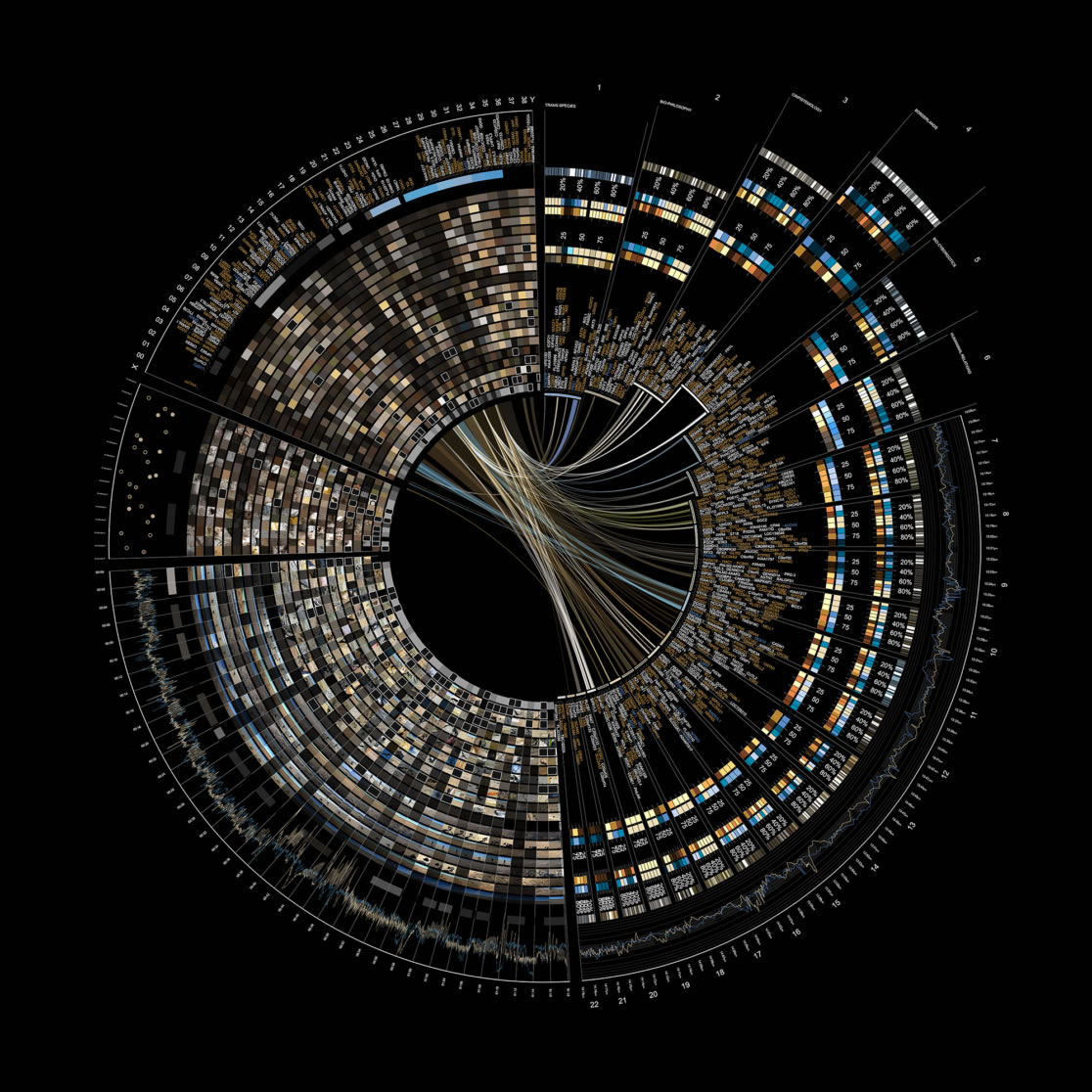
Ruby, a PTSD Assistance Canine and I share 84% of the same DNA, it makes me wonder why the 16% deficit defines Ruby’s otherness.
When sensory data is compared between both species there is little difference. It is in differencing that I think valuable insights and opportunities are lost - look for similarities and the world looks a very different proposition.
Medium
Comparative human and canine DNA and sensory data visualisation.
Image type
Digital C-Type print, flush-mounted on 3mm Alupanel
Dimensions
150 x 150 x 3 mm
Critical context
Interspecies collaboration, as discussed in “When Species Meet” by Haraway (2008), challenges traditional notions of difference and othering by emphasizing mutual respect and cooperation. Unlike historical animal-human relations, where animals and the disabled were often marginalized or exploited, collaborative efforts acknowledge the unique contributions of all participants, regardless of species or ability. This approach fosters a trans-species social reciprocity and a deeper understanding of interconnectedness, transcending hierarchical power dynamics to promote beneficial contemporary humanimal partnerships and coexistence.
Main explorative points:
1. Evolutionary Survival Instinct:
Throughout human history, identifying differences has been crucial for survival. Early humans needed to quickly distinguish friend from foe, prey from predator, and safe from dangerous environments. This instinct to prioritize differences persists in modern humans, as it helps us assess potential threats and navigate complex social dynamics.
2. Cognitive Efficiency:
Our brains are wired to process information efficiently, and focusing on differences allows for quicker categorization and decision-making. By immediately recognizing what sets something apart, we can allocate cognitive resources more effectively, saving time and energy compared to thoroughly analyzing similarities.
3. Social Identity Formation:
Humans are inherently social beings, and understanding differences plays a central role in shaping individual and group identities. By highlighting distinctions between individuals or groups, humans establish boundaries, hierarchies, and alliances, contributing to a sense of belonging and cohesion within communities.
4. Cultural Conditioning:
Societal norms, values, and biases influence how we perceive the world around us. Cultural conditioning often emphasizes differences, whether based on ethnicity, nationality, religion, or other factors. Consequently, individuals may be predisposed to focus on dissimilarities as a result of cultural indoctrination and societal expectations.
5. Confirmation Bias:
Humans tend to seek information that confirms preexisting beliefs or expectations while disregarding evidence that contradicts them. This cognitive bias can lead individuals to actively search for differences that align with their worldview, reinforcing existing attitudes and perspectives while overlooking similarities that challenge their assumptions.
Citations:
Adams, M. 2016. Embodied Entanglements: Exploring Trans-Species. In: Ecological Crisis, Sustainability and the Psychosocial Subject. Studies in the Psychosocial. Palgrave Macmillan, London. https://doi.org/10.1057/978-1-137-35160-9_10
Bradshaw, G. 2010. You see me, but do you hear me? The science and sensibility of trans-species dialogue. Feminism & Psychology, 20(3), 407-419. https://doi.org/10.1177/0959353510368285
Haraway, D. J. 2015. Anthropocene, Capitalocene, Plantationocene, Chthulucene: Making Kin. Environmental Humanities 1 May 2015; 6 (1): 159–165. doi: https://doi.org/10.1215/22011919-3615934
Haraway, Donna J. 2008. When Species Meet. Minneapolis: University of Minnesota Press.
Krzywinski, M. 2009. Circos: an Information Aesthetic for Comparative Genomics. Genome Research. 19:1639-1645 http://circos.ca/
Staszak, Jean-François. 2009. Other/Otherness. In: International Encyclopedia of Human Geography: A 12-Volume Set. Oxford : Elsevier Science. https://www.unige.ch/sciences-societe/geo/files/3214/4464/7634/OtherOtherness.pdf