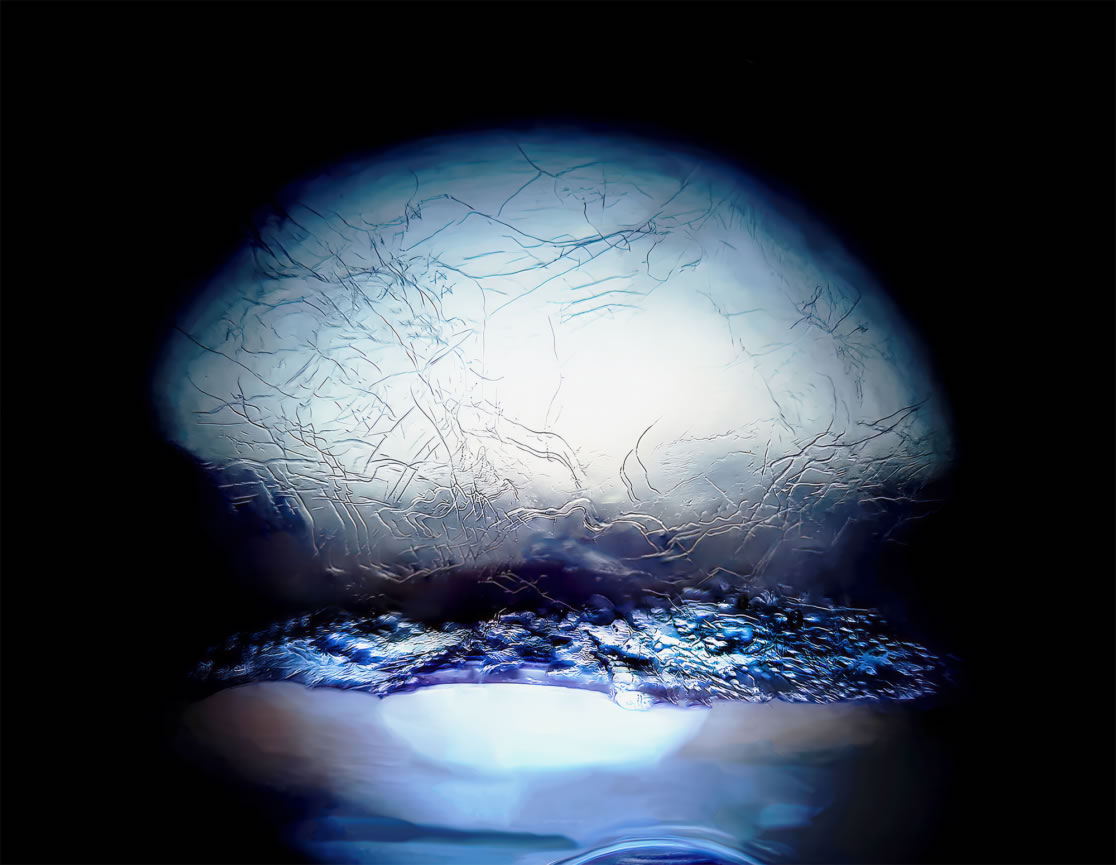
Bio-cyborgotics
Employing cyborg theory to examine the concept of embodiment can demonstrate how bio-cyborgs have the potential to disrupt the binary distinctions between normal and abnormal, non-disabled and disabled, as exemplified in the case of individuals living with technology and the non-human.
Embracing both, as many disabled individuals do, may introduce novel ways of existence and directly question the prevailing definition of 'normal,' especially when the assistive animal/device more than effectively fulfills its physical and/or psychological functions.
Medium
PTSD canine and human DNA cultured on agar
Image type
Digital C-Type print, flush-mounted on 3mm Alupanel
Dimensions
150 x 100 x 3 mm
Critical context
My personal style of 'Cyborg theory' offers a lived experience, a harmonious synthesis where humans, canines, and digital entities merge into a collaborative identity. The posthumanist and trans-humanist concepts erase traditional boundaries between species and technology, proposing a collective being that integrates their strengths and defining characteristics that contribute to its coupled hybridity. Humans offer cognitive and emotional depth, demonstrating complex problem-solving skills and rich emotional landscapes. Canines contribute not only heightened senses and social intelligence but acute emotional sensitivity, and innovative problem-solving skills. Digital entities provide computational organization skills and digital connectivity, enabling the digital augmentation that records human and canine datasets.
This synthesis of human, canine, and digital creates a composite entity, that embodies and facilitates a deeper understanding and interaction across species and technologies. It marks a shift towards a future where identities are fluid and collaborative, emphasizing the potential to forge new forms of unity and coexistence across the biological and digital spectrum. Through this collaborative perspective, cyborg theory celebrates the possibilities of cross-species synergy, envisioning a future where diverse forms of intelligence and capability converge in shared purpose and existence.
Employing cyborg theory to examine the concept of embodiment can demonstrate how disabled cyborgs have the potential to disrupt the binary distinctions between normal and abnormal, non-disabled and disabled, as exemplified in the case of individuals living with technology and the non-human. Embracing both, as many disabled individuals do, may introduce novel ways of existence and directly question the prevailing definition of ‘normal,’ especially when the assistive animal/device more than effectively fulfills its physical and/or psychological functions.
Main explorative points:
Disrupting Traditional Notions of Identity:
Explore how the coupling of disabled humans, PTSD assistance canines, and technology challenges established notions of identity and embodiment. Consider how this collaboration blurs the boundaries between human and non-human, normal and abnormal, and the implications for understanding identity within a critical studies framework.
Societal Shifts and Accommodation of Disability:
Investigate the broader societal implications of embracing novel forms of embodiment. Analyze how these disruptions to traditional categories prompt shifts in societal attitudes and practices regarding disability accommodation, accessibility, and inclusion.
Agency, Autonomy, and Power Dynamics:
Examine the dynamics of agency, autonomy, and power within these collaborative embodiments. Critically evaluate how the introduction of technology and non-human entities affects the agency and autonomy of disabled individuals, and consider the power dynamics at play in these relationships.
Digital Education and Accessible Learning:
Explore the role of digital education platforms in facilitating accessible learning for disabled individuals within these collaborative-creative embodiments. Explore how technology enhances educational opportunities, challenges barriers to learning, and fosters empowerment and self-determination.
Intersections of Technology, Disability, and Animal Studies:
Situate the analysis within the intersections of technology, disability studies, and animal studies. Consider how my insights from these fields enrich our understanding of collaborative embodiments and offer new perspectives on the relationships between humans, animals, and technology.
Citations:
Bradshaw, G. 2010. You see me, but do you hear me? The science and sensibility of trans-species dialogue. Feminism & Psychology, 20(3), 407-419. https://doi.org/10.1177/0959353510368285
Haraway, Donna J. 2008. When Species Meet. Minneapolis: University of Minnesota Press.
Kent, M., Ellis, K., Garland-Thomson, R., & Robertson, R. (Eds.). 2018. Manifestos for the Future of Critical Disability Studies: Volume 1 (1st ed.). Routledge. https://www.taylorfrancis.com/books/edit/10.4324/9781351053341/manifestos-future-critical-disability-studies-mike-kent-katie-ellis-rosemarie-garland-thomson-rachel-robertson
Haraway, D. 1997. A Cyborg Manifesto: Science, Technology, and Socialist-Feminism in the Late 20th Century. In: Weiss, J., Nolan, J., Hunsinger, J., Trifonas, P. (eds) The International Handbook of Virtual Learning Environments. Springer, Dordrecht. https://doi.org/10.1007/978-1-4020-3803-7_4
Nocella, Anthony J., Amber E. George, and J. L. Schatz. 2017. The intersectionality of critical animal, disability, and environmental studies: toward eco-ability, justice, and liberation. Rowman & Littlefield. US.
Northoff, Georg and Panksepp, Jaak. 2008. The trans-species concept of self and the subcortical–cortical midline system, Trends in Cognitive Sciences, Volume 12, Issue 7, Pages 259-264, https://www.sciencedirect.com/science/article/pii/S1364661308001368
Verspaget, C. J. 2016. Unruly Bodies: Monstrous Reading of Biotechnology (PhD thesis, Western Australia, Curtin University, 2016). Western Australia: Curtin University. Retrieved from https://espace.curtin.edu.au/bitstream/handle/20.500.11937/1994/240083_Verspaget%202016%20partial.pdf?isAllowed=y&sequence=2
Reeve, Donna. 2012. Disability and Social Theory: New Developments and Directions. Cyborgs, Cripples and iCrip-reflections on the contribution of Haraway to Disability Studies., Palgrave Macmillan UK. ProQuest Ebook Central, https://ebookcentral.proquest.com/lib/curtin/detail.action?docID=931694.
Siebers, T. 2008. Disability Theory. Ann Arbor, MI: University of Michigan Press. Personal Kindle edition
Wolfe, C. 2010. What is posthumanism? Minnesota: University of Minnesota Press.
Wolfe, Cary. 2020. "The Biopolitical Drama of Joseph Beuys." New Literary History 51 (4) (Autumn): 835-854. https://www.proquest.com/scholarly-journals/biopolitical-drama-joseph-beuys/docview/2494379881/se-2.
Wolfe, Cary. 2021. Art and Posthumanism (Art After Nature) (p. 86). University of Minnesota Press. Personal Kindle Edition.