Digital Pathways - Curtin
By focusing on creativity and adaptability, digital education can be reimagined to better address the evolving needs and challenges of disability learners and educators alike. This perspective opens up possibilities for learning to become more accessible, engaging, effective, and responsive, ultimately leading to increased disability participation to education in the digital age.
Medium
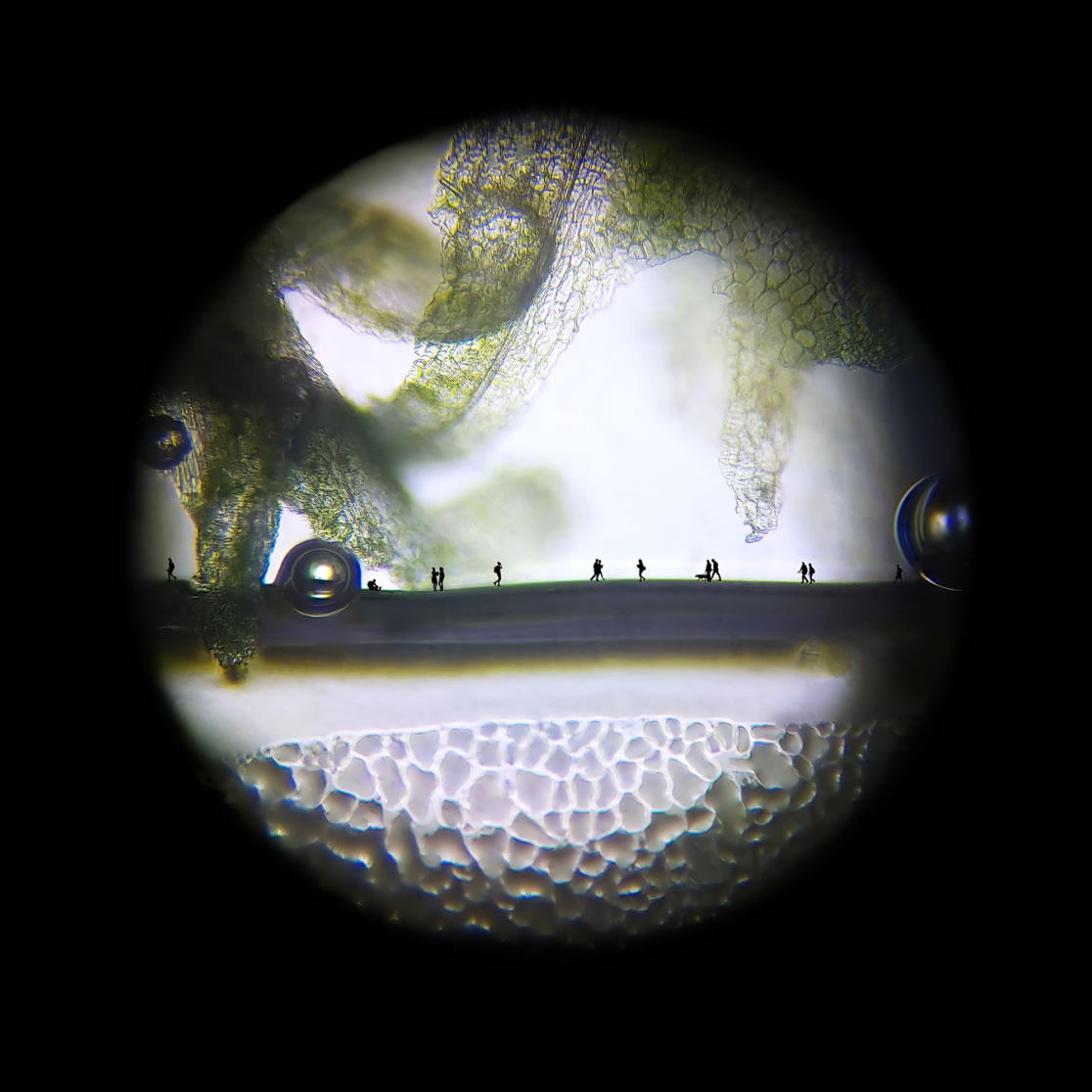
Canine olfactory sourced university biota with digital overlays
Image type
Digital C-Type print, flush-mounted on 3mm Alupanel
Dimensions
150 x 150 x 3 mm
Critical context
“Allowing for disability educational spaces that encourage imagination and embrace radical departures from ‘what is’ fosters the development of creative spaces in which we can explore alternatives that are situational, local and in support” (Nocella, Amber & Schalz, 2017, 63-76)The initial step of allowing for disability educational spaces involves embracing radical teaching and learning methods, collaborating with self-advocates to collectively reconsider the assumptions that shape how humans construct meaning. From my disability/posthumanist viewpoint, this process extends to (re)evaluating how we learn to relate to each other and the broader, more-than-human world. The subsequent step entails my engagement in critical and ethical (re)conceptualizations and (re)imagining’s.
Rough notes: The less formal creative avenue – BA (Fine Arts) – was paramount in my ability to explore, define and then participate in expressing my own disability knowledge. I need to group the educational parameters that led me to completing my degree via a digital format. What are the impacts post-degree and can I articulate a relatable educational pathway for others who are PTSD disabled or experiencing mental health issues?
Main explorative points:
Critical Pedagogy:
1./ Emphasizes questioning traditional teaching methods. 2./ Encourages critical thinking and social awareness. 3./ Fosters a transformative and equitable educational experience.
Cultural Influences in Education:
1./ Acknowledges the impact of cultural diversity on learning. 2./ Promotes inclusive curricula reflective of various cultures. 3./ Recognizes cultural sensitivity in educational practices.
Disability Advocacy in Education:
1./ Champions equal access and opportunities for disabled students. 2./ Addresses systemic barriers in educational settings. 3./ Promotes inclusive policies and accommodations.
Ethical Education Practices:
1./ Embeds moral principles in teaching and learning. 2./ Nurtures ethical decision-making and responsible behavior. 3./ Considers societal values and ethical standards.
Inclusive Education:
1./ Ensures accessibility for all students, regardless of abilities. 2./ Fosters a supportive and diverse learning environment. 3./ Emphasizes collaboration and acceptance.
Radical Departures in Learning:
1./ Challenges conventional teaching methodologies. 2./ Encourages innovative and transformative approaches. 3./Fosters creative thinking and unconventional perspectives.
Citations:
Ellis, Katie. 2014. The Voice Australia (2012): disability, social media and collective intelligence, Continuum, 28:4, 482-494, https://www.tandfonline.com/doi/full/10.1080/10304312.2014.907874
Ellis, K., T. Pitman, T., Kent, M., V. Mancini, and L. McRae. 2021. "Mainstreaming accessible digital technologies in higher education: a human rights approach to disability inclusion." In Activating Cultural and Social Change, 227-240: Routledge. https://www.tandfonline.com/doi/full/10.1080/10304312.2014.907874
Hoffman, Aimie and Blessinger, Patrick. 2021. International Perspectives on Supporting and Engaging Online Learners: Innovations in Higher Education Teaching and Learning Volume 39. Emerald Publishing Limited https://www.emerald.com/insight/publication/doi/10.1108/S2055-3641202139
Kent, M., Ellis, K., Garland-Thomson, R., & Robertson, R. (Eds.). 2018. Manifestos for the Future of Critical Disability Studies: Volume 1 (1st ed.). Routledge. https://www.taylorfrancis.com/books/edit/10.4324/9781351053341/manifestos-future-critical-disability-studies-mike-kent-katie-ellis-rosemarie-garland-thomson-rachel-robertson
Kent, Mike, Katie Ellis, and Matt Giles. 2018. "Students with Disabilities and eLearning in Australia: Experiences of Accessibility and Disclosure at Curtin University." TechTrends 62 (6) (11): 654-663. doi:https://doi.org/10.1007/s11528-018-0337-y. https://www.proquest.com/scholarly-journals/students-with-disabilities-elearning-australia/docview/2112952914/se-2.
Nocella, Anthony J., Amber E. George, and J. L. Schatz. 2017. The intersectionality of critical animal, disability, and environmental studies: toward eco-ability, justice, and liberation. Rowman & Littlefield. US.
Dolmage, Jay Timothy. 2017. Academic Ableism: Disability and Higher Education. University of Michigan Press. http://www.jstor.org/stable/j.ctvr33d50
Johnson, Lisa & Mcruer, Robert. 2014. Cripistemologies: Introduction. Journal of Literary & Cultural Disability Studies. 8. 127-147. https://muse.jhu.edu/article/548847/pdf
Chandler, Eliza, Aubrecht, Katie, Ignagni, Esther and Rice, Carla. 2021. “Cripistemologies of Disability Arts and Culture: Reflections on the Cripping the Arts Symposium (Editors’ Introduction).” Studies in Social Justice 15 (2): 170-179. https://www.proquest.com/scholarly-journals/cripistemologies-disability-arts-culture/docview/2538052982/se-2