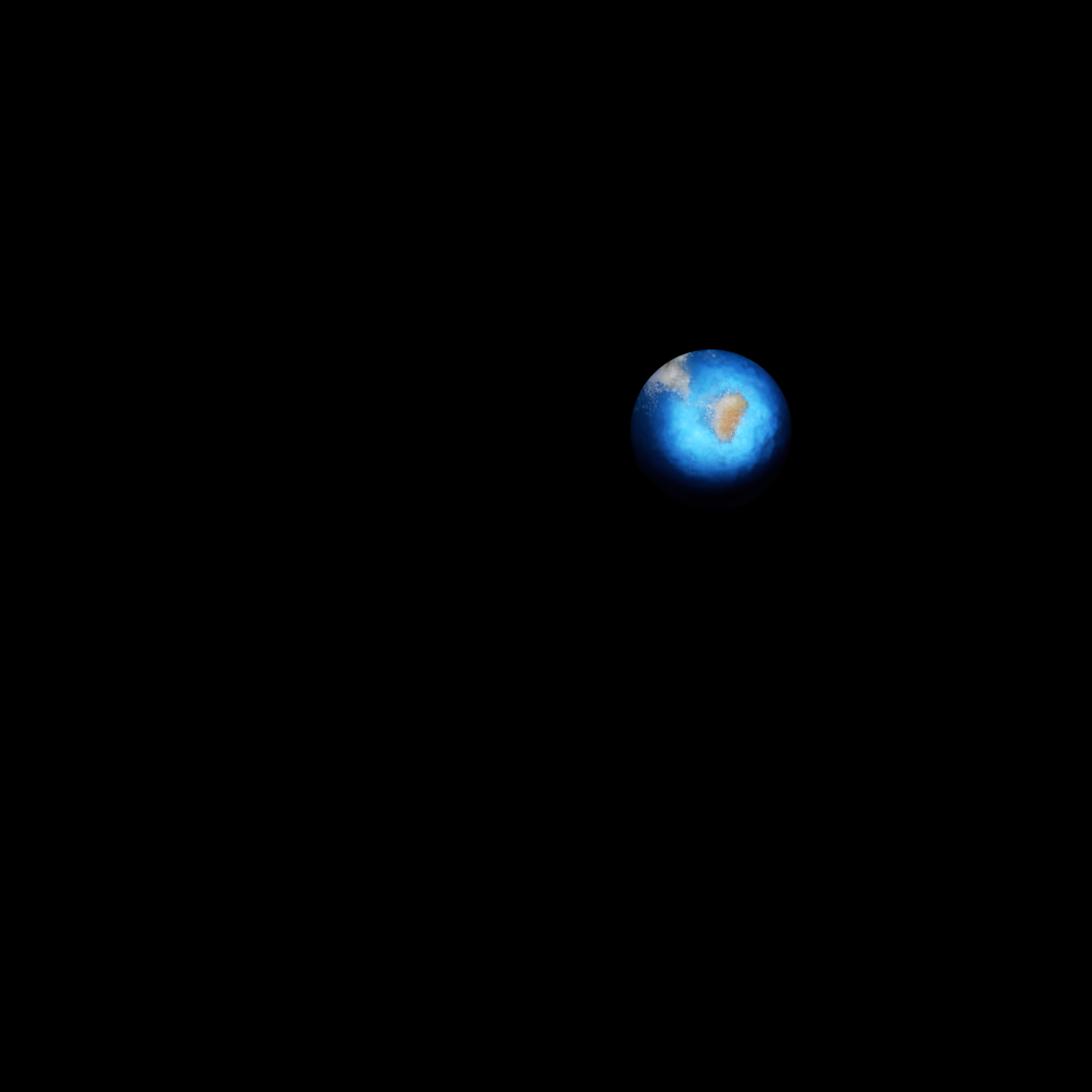
The Borderlands
The Borderlands can be dynamic spaces where diverse sub-cultures converge and communicate with dominant societal ideals.
The borderland embodies adaptability, and a shared commitment to break down barriers, transforming what was once perceived as ‘different’ ‘othered’ or unknown, into alternative spaces of growth, symbiosis, coexistence and collaborative social enrichment.
Medium
PTSD canine and human DNA cultured on agar
Image type
Digital C-Type print, flush-mounted on 3mm Alupanel
Dimensions
150 x 150 x 3 mm
Critical context
“Borders are set up to define the places that are safe and unsafe, to distinguish us from them. A border is a dividing line, a narrow strip along a steep edge. The borderlands is a vague and undetermined place created by the emotional residue of an unnatural boundary. It is in a constant state of transition. The prohibited and forbidden are its inhabitants.” Gloria E. Anzaldúa.The concept of the borderlands, a metaphorical space where different cultures, languages, and identities intersect. While Anzaldúa’s theory primarily addresses issues related to cultural, linguistic, and gender identities, aspects of borderland theory can also be applied to disability studies, particularly in assisting understanding of the intersections of PTSD disability with non-human social categories.
Gloria Anzaldúa’s borderland theory offers others valuable insights into fluid identities, cultural competence, challenging binaries, the role of language, animal intersectionality, and cultural sensitivity. By incorporating these multiple and critical perspectives, PTSD Disability Studies can offer a more nuanced and contemporary understanding of disability within traditional or dominant cultural landscapes.
Main explorative points:
Intersectionality:
Anzaldúa’s borderland theory embraces intersectionality, acknowledging that individuals inhabit multiple identities and navigate complex intersections of culture, race, gender, and language. Disability studies can benefit by adopting a similarly intersectional approach, recognising that disability intersects with other aspects of identity, influencing the experiences of individuals with disabilities and their animal cohorts.
Fluid Identity and Embodiment:
Anzaldúa emphasises the fluidity of identity in the borderlands, where individuals negotiate and navigate diverse cultural landscapes. Disability studies can draw from this idea to recognise the fluidity of disability identity and embodiment. Understanding disability as a dynamic and evolving aspect of identity helps challenge static and medicalised perspectives.
Cultural Competence and Inclusion:
Anzaldúa’s work promotes cultural competence and the inclusion of diverse perspectives. Applying this to disability studies involves recognising and valuing the diversity of disability experiences within different cultural contexts. It encourages a more inclusive approach that considers how cultural factors impact the understanding and experiences of disability.
Challenging Binaries:
Anzaldúa challenges binary thinking, advocating for the dissolution of rigid categories and embracing hybridity. In the context of disability studies, this challenges the dichotomy between disabled and non-disabled, encouraging a more nuanced understanding of disability as a spectrum with varying experiences and abilities.
Language and Communication:
Anzaldúa emphasises the importance of language in the borderlands. Disability studies can benefit by considering the role of language and communication in shaping perceptions of disability. This includes recognising the diversity of communication methods and challenging ableist language and narratives that perpetuate stigmas.
Cultural Sensitivity:
Anzaldúa’s borderland theory promotes cultural sensitivity and understanding. In disability studies, this translates into recognising and respecting the cultural contexts in which disability is experienced. Understanding how cultural beliefs and practices influence the perception and treatment of disability is essential for more culturally sensitive approaches. This microphotograph was created by combining a disabled persons and a PTSD assistance canines DNA in a petri dish to signify the close bond and ties one develops when living with an assistance animal. It looks like a strange and isolated planet floating in space and its main purpose is to signify the isolation one feels when mainstream thinking others us because of our differences and assigns us to the borders of society. On a positive note, this planetary affordance is not only at the borderlands of difference, but also a psychological and digital space – it can be an open liminal meeting space where the marginalised and the collective can begin to crossover – it can be an entry point that welcomes the transitioning of understanding with each other.
Citations:
Anzaldúa, Gloria. 1987.Borderlands = La Frontera : The New Mestiza. San Francisco, Spinsters/Aunt Lute. Personal Kindle Edition.
Anzaldúa, Gloria and Keating, Ana Louise. 2015. Light in the Dark = Luz En Lo Oscuro : Rewriting Identity Spirituality Reality. Durham North Carolina: Duke University Press. Personal Kindle Edition
Bradshaw, G. 2010. You see me, but do you hear me? The science and sensibility of trans-species dialogue. Feminism & Psychology, 20(3), 407-419. https://doi.org/10.1177/0959353510368285
Haraway, Donna J. 2008. When Species Meet. Minneapolis: University of Minnesota Press.
Nocella, Anthony J., Amber E. George, and J. L. Schatz. 2017. The intersectionality of critical animal, disability, and environmental studies: toward eco-ability, justice, and liberation. Rowman & Littlefield. US.
Verspaget, C. J. 2016. Unruly Bodies: Monstrous Reading of Biotechnology (PhD thesis, Western Australia, Curtin University, 2016). Western Australia: Curtin University. Retrieved from https://espace.curtin.edu.au/bitstream/handle/20.500.11937/1994/240083_Verspaget%202016%20partial.pdf?isAllowed=y&sequence=2