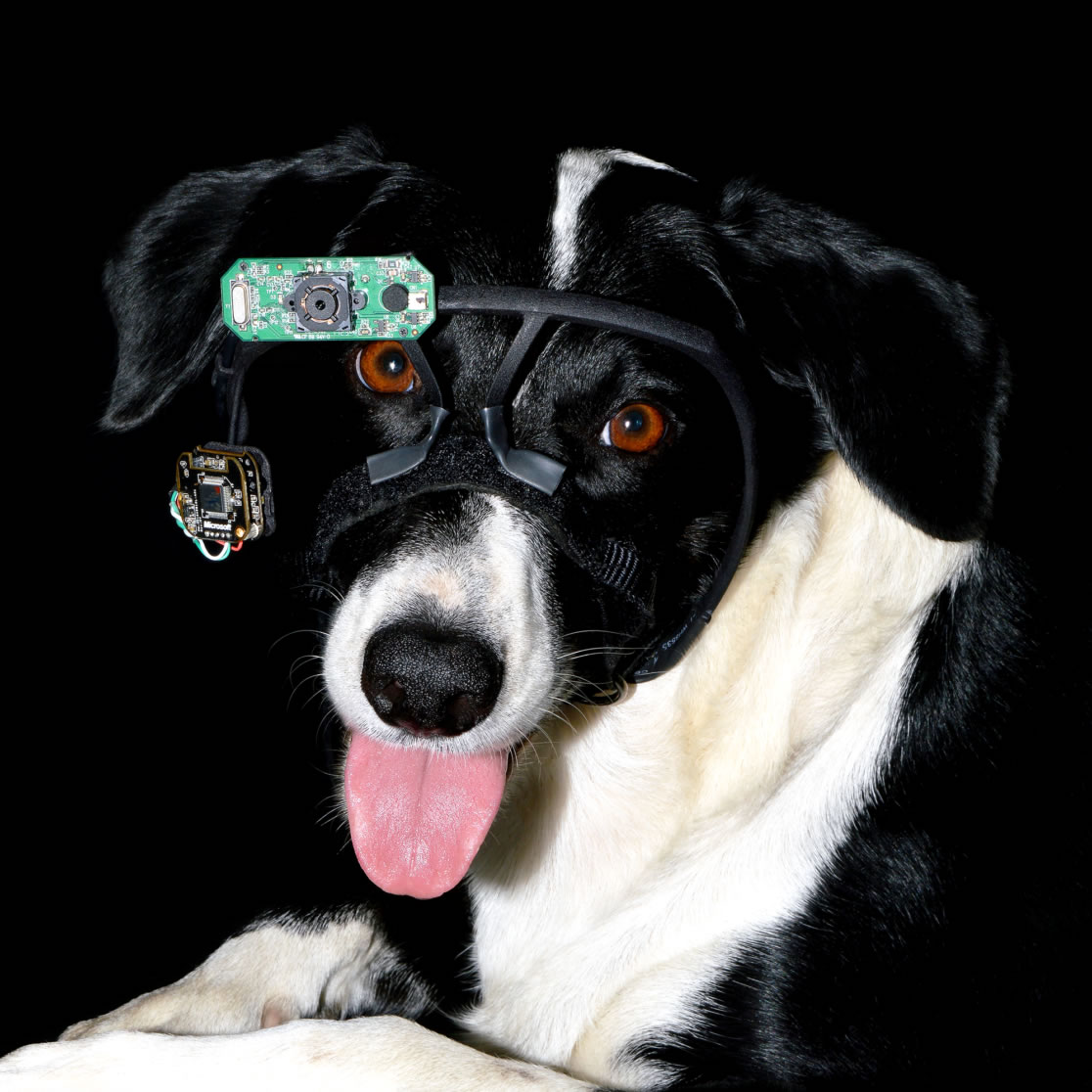
Learnt
In the 21st century: Creating human and canine collaborative and exclusive bio-research environments that embrace radical departures from the status quo is crucial for cultivating cutting edge bio-philosophical theories. In these posthumanimal spaces, we can explore and actually experience situational alternatives that encourage the development of completely new and beneficial perspectives and understandings.
Medium
Canine and human interchangeable eye trackers.
Image type
Digital C-Type print, flush-mounted on 3mm Alupanel
Dimensions
150 x 150 x 3 mm
Critical context
“Dogs have indeed special skills to understand and interact with humans due to the evolutionary history and domestication of the species and due to complex competences acquired by individual and social learning. We see accumulating evidence of their understanding of human emotions, gestures, and actions and of how much they are thus part of human culture and our social game. Bonds between dogs and humans are selective, intense, and vary in quality. Affiliation plays a motivational role in dog behavior and shapes the dogs’ attitudes as well as their interaction with humans. ” (Benz-Schwarzburg, Monsó & Huber 2020)Dogs’ possess an ability to align their actions with human goals which stems from a combination of factors rooted in our evolutionary history, domestication, and individual and social learning abilities. (Benz-Schwarzburg, Monsó & Huber 2020) (Topál & Gácsi 2012)
Main explorative points:
1. Evolutionary History and Domestication:
Dogs have evolved alongside humans for thousands of years, leading to a symbiotic relationship between the two species. Through domestication, dogs have developed traits that make them particularly adept at understanding and interacting with humans. This includes traits such as heightened social intelligence, attentiveness to human cues, and a predisposition towards forming bonds with humans.
2. Social Learning:
Dogs are highly social animals that have a remarkable capacity for learning from both humans and other dogs. They can observe and mimic human behavior, allowing them to understand and anticipate human actions and goals. Through social learning, dogs can acquire a repertoire of behaviors that are aligned with human goals, such as fetching objects, responding to commands, or assisting with various tasks.
3. Individual Learning:
Dogs like humans possess the ability to learn through individual experiences and reinforcement. When collaborative learning environments are utilised both species work together and learn at a rate faster than anthropocentric master and servant relationships. Living, working and playing in a disability context, the canine and human learn intuitively and can learn to do many things that a pet can not.
4. Understanding Human Communication:
Dogs have demonstrated an impressive ability to understand human communication cues, including verbal commands, gestures, and body language. Through this understanding, dogs can infer human intentions and goals, allowing them to cooperate with humans in various activities and tasks. For instance, a dog may learn to follow pointing gestures to locate hidden objects or to interpret vocal cues indicating desired actions.
5. Bond and Affiliation with Humans:
The strong bonds that dogs form with their human companions also play a significant role in aligning their actions with human goals. Dogs are motivated to please and cooperate with their bonded humans, leading them to actively seek opportunities to engage in behaviors that are perceived as desirable or beneficial by their human counterparts. This motivation to maintain positive social interactions and affiliations with humans drives dogs to align their actions with human goals to a great extent.
"The dogs’ and humans ability to align their actions is facilitated by their evolutionary history, domestication, social and individual learning abilities. These factors collectively enable both species to integrate seamlessly, contributing to their symbiotic roles as valued companions, helpers, and even working partners. (trans-species collaboration)"
Citations:
Benz-Schwarzburg, J., Monsó, S., & Huber, L. 2020. How Dogs Perceive Humans and How Humans Should Treat Their Pet Dogs: Linking Cognition With Ethics. Frontiers in psychology, 11, 584037. https://doi.org/10.3389/fpsyg.2020.584037
Charles, N. 2016. Post-Human Families? Dog-Human Relations in the Domestic Sphere. Sociological Research Online, 21(3), 83-94. https://doi.org/10.5153/sro.3975
Kac. 1995. “Telepresence Garment.” Ekac. 1995, https://www.ekac.org/telepgarm.html
Topál J., Gácsi M. 2012. “Lessons we should learn from our unique relationship with dogs: an ethological approach” in Crossing boundaries. eds. Birke L., Hockenhull J. Boston & Leiden: Brill Academic Press; , 163–187.
Wolfe, C. 2010. What is posthumanism? Minnesota: University of Minnesota Press.