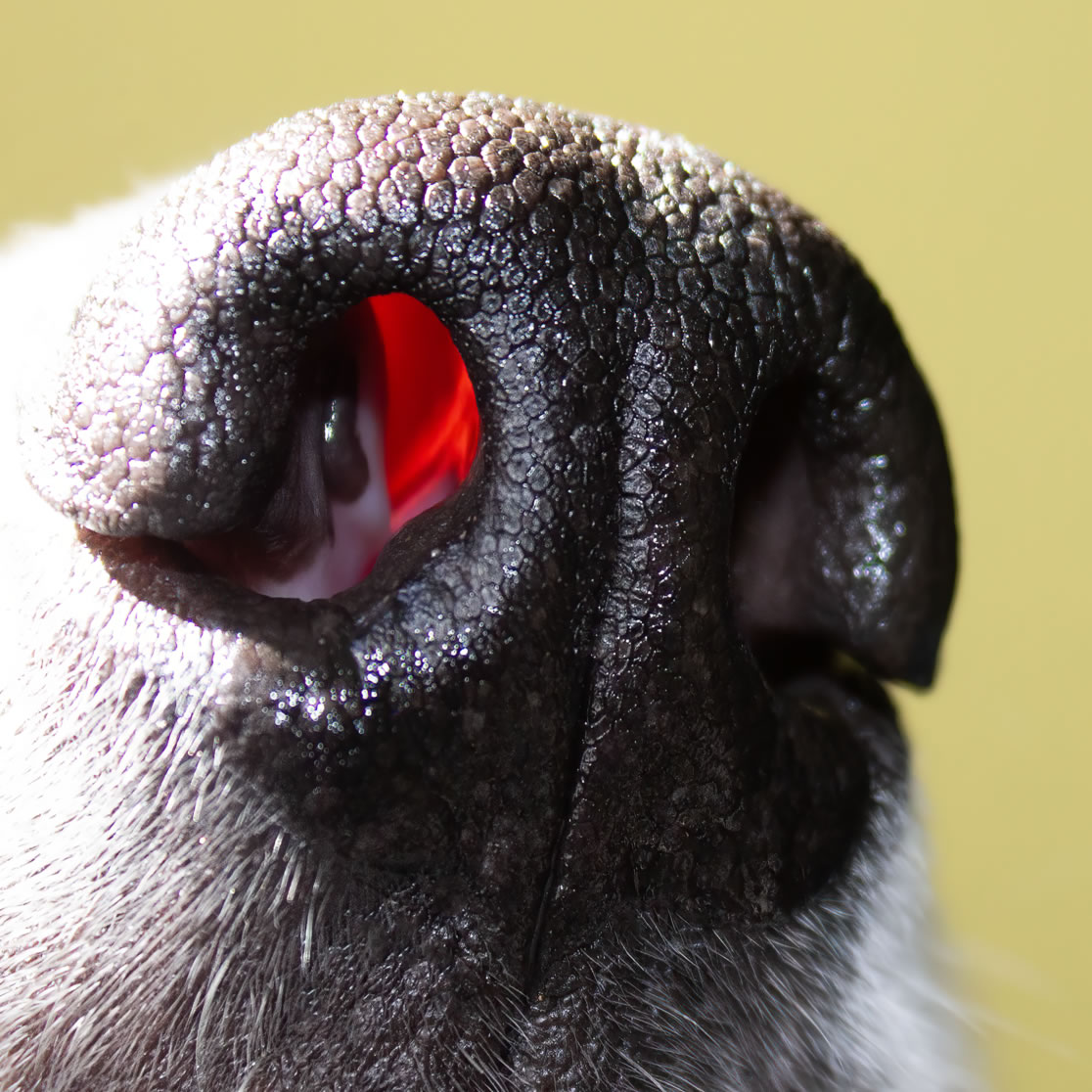
x 10,000
Research shows that PTSD Service Dogs not only provide emotional support to their owners but also possess an uncanny ability to detect changes in their human’s cortisol levels—a stress hormone. This unique bond allows the dog to intervene and offer comfort before their owner may even realize they’re experiencing distress.
Medium
Digital photograph
Image type
Digital C-Type print, flush-mounted on 3mm Alupanel
Dimensions
150 x 150 x 3 mm
Critical context
Canines in general possess remarkable olfactory abilities, enabling them to discriminate between human breath and sweat samples even amidst psychological stress. Wilson’s et.al (2022) study explored the potential of volatile organic compounds (VOCs) associated with acute stress, detectable by trained dogs. Their positive findings and confirmation offer insights into the potential applications in service dog training and deepen our understanding of the human-dog relationship.
Main explorative points:
1. How does canine olfactory abilities assist humans with PTSD?
- Dogs demonstrate high accuracy in discriminating between human breath and sweat samples under stress.
- Trained dogs can detect a volatile organic compound (VOC) profile associated with acute psychological stress.
- Potential applications include utilizing this odor as a training aid for service dogs responding to stress in their owners.
- Understanding dogs’ ability to detect stress-related odors contributes to our knowledge of the human-dog relationship.
- Future research is needed to identify the specific odor detected by dogs, its duration of detectability, and its potential interactions with chronic stress responses.
- (Wilson et. al (2022) positive findings summary)
Citations:
Contractor, A. A., Weiss, N. H., Forkus, S. R., & Keegan, F. 2022. Positive Internal Experiences in PTSD Interventions: A Critical Review. Trauma, Violence, & Abuse, 23(1), 101–116. https://doi.org/10.1177/1524838020925784
Gerwisch, Karoline., Weissenbacher, Karl ., Proyer, Michelle & Huber, Ludwig. 2023. A pilot study into the effects of PTSD-assistance dogs’ work on their salivary cortisol levels and their handlers’ Quality of life, Journal of Applied Animal Welfare Science, DOI: 10.1080/10888705.2023.2259795
Hediger, K., Wagner, J., Künzi, P., Haefeli, A., Theis, F., Grob, C., Pauli, E., & Gerger, H. 2021. Effectiveness of animal-assisted interventions for adults with post-traumatic stress disorder symptoms: a systematic review and meta-analysis. European journal of psychotraumatology, 12(1), 1879713. https://doi.org/10.1080/20008198.2021.1879713
Wilson, Clara, Kerry Campbell, Zachary Petzel, and Catherine Reeve. 2022. “Dogs can Discriminate between Human Baseline and Psychological Stress Condition Odours.” PLoS One 17 (9) (09). doi:https://doi.org/10.1371/journal.pone.0274143. https://www.proquest.com/scholarly-journals/dogs-can-discriminate-between-human-baseline/docview/2718856385/se-2.
Winkle, Melissa, Johnson, Amy and Mills, Daniel. 2020. “Dog Welfare, Well-being and Behavior: Considerations for Selection, Evaluation and Suitability for Animal-Assisted Therapy.” Animals 10 (11): 2188. doi:https://doi.org/10.3390/ani10112188. https://www.proquest.com/scholarly-journals/dog-welfare-well-being-behavior-considerations/docview/2524376693/se-2.
Woodward, S. H. , Jamison, A. L. , Gala, S. , Lawlor, C. , Villasenor, D. , Tamayo, G. & Puckett, M. 2021. Tracking Positive and Negative Affect in PTSD Inpatients During a Service Dog Intervention. Journal of Consulting and Clinical Psychology, 89 (6), 551-562. https://oce.ovid.com/article/00004730-202106000-00006/HTML