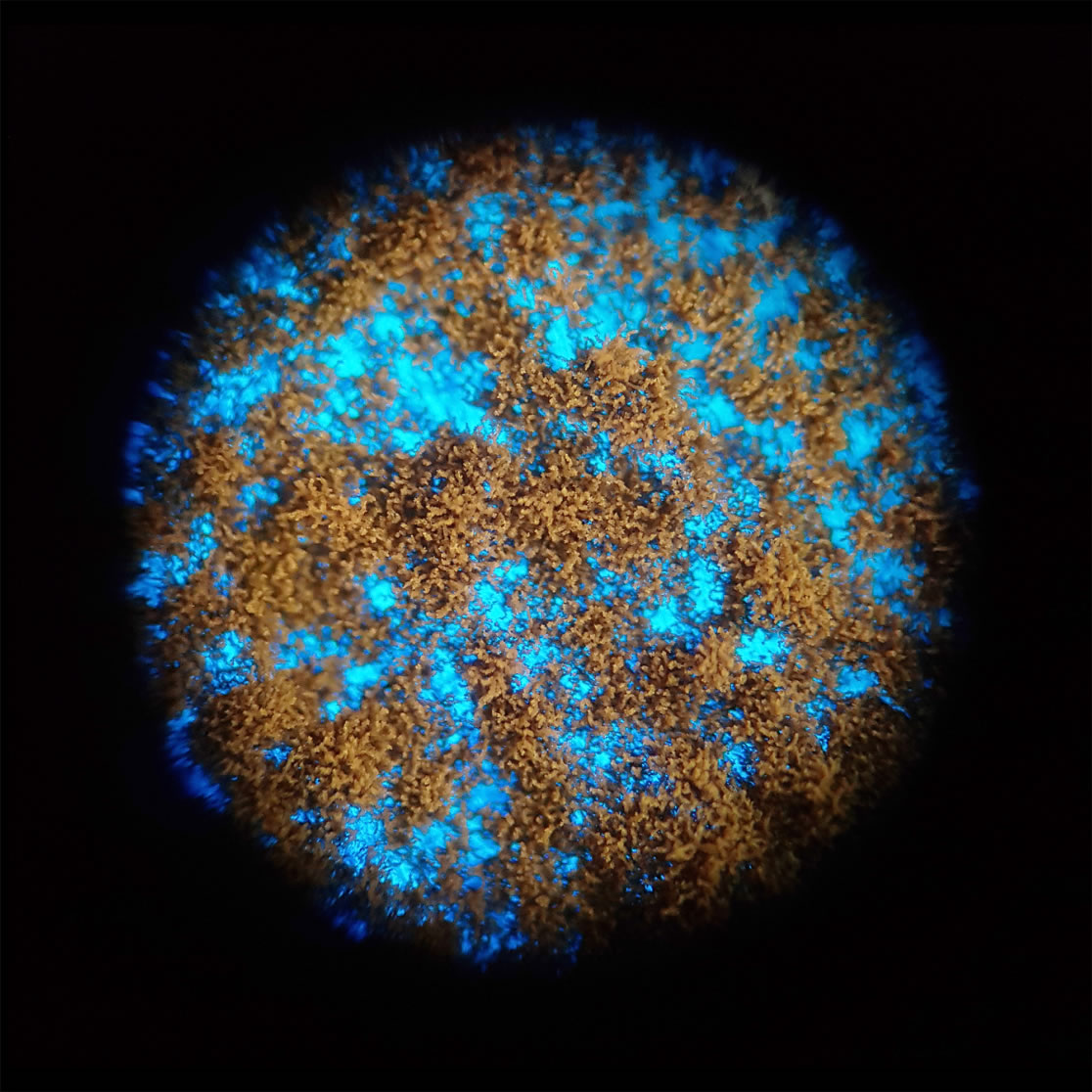
Trans-species DNA
‘Trans-species DNA’ is informed by bio-philosophy, trans-species psychology, posthumanist and feminist theory. I draw on a range of interdisciplinary perspectives to explore the complexities of a PTSD disabled person and a PTSD assistance dogs close knit relationship. It visually argues that humans are not fundamentally different from other species but are entangled in complex and dynamic ways.
Medium
PTSD canine and human DNA cultured on agar
Image type
Digital C-Type print, flush-mounted on 3mm Alupanel
Dimensions
150 x 150 x 3 mm
Critical context
Donna Haraway’s (1997) (2008) concept of hybridity refers to the blurring of boundaries and the merging of diverse entities, challenging fixed categories. In her work, “A Cyborg Manifesto,” she envisions a world where the distinctions between the human, organism and machine, intertwine. Haraway sees hybridity as a liberating force, offering new possibilities and identities that defy conventional norms. By embracing interspecies hybridity, she advocates for a more fluid understanding of existence that transcends traditional binaries and hierarchies, suggesting a natural coexistence that manifests in rich and interconnected human and animal relationships. (Haraway 1997)
“Trans-species DNA” is a bio-political provocation that critiques interspecies relationships through the symbiotic entanglement of a disabled human’s and a canine’s DNA. This piece transcends binary distinctions, aligning itself with critical bio-philiosophical discourse that advocates for a world where traditional roles of humans and their canine companions are redefined. It invites viewers to challenge entrenched perceptions of disability and pet ownership, prompting a reconsideration of collaborative interactions that exist between these two socially compatible species. The work calls for a reassessment of anthropocentric social models, as the combined DNA contains a performative narrative that captures the esscence of trans-species camaraderie and collaboration. More than a visual exploration, “Trans-species DNA” is a lived dialogic proposition that advances conversations about human and animal relations, interdependence, and the ingenuity born from a partnership of humans and assistance canines, especially in the context of addressing human PTSD.
Main explorative points:
Disability Narratives:
Personal or collective stories that convey the experiences of individuals with disabilities. The artwork centres on the personal narratives and experiences of individuals with disabilities, particularly those who rely on PTSD Assistance Canines for support. It challenges ableist assumptions and promotes a more inclusive understanding of disability by highlighting the unique bonds and ties experienced between humans and animals.
Human-Animal Relations:
The dynamic and varied interactions between humans and animals, exploring the emotional, social, and cultural aspects of these relationships. Through the portrayal of intertwined DNA, the artwork delves into the dynamic and varied interactions between humans and animals, highlighting the emotional, social, and cultural aspects of these relationships. It emphasises the close bond between PTSD Assistance Canines and humans, inviting viewers to reflect on the complexities of interspecies relationships.
Hybridity:
Blurring or blending of boundaries between different categories, challenging fixed distinctions and promoting a more fluid understanding. The artwork challenges fixed categories and promotes a more fluid understanding of existence, echoing Donna Haraway’s concept of hybridity. By visually blurring the boundaries between human and canine DNA, it emphasises the interconnectedness of different life forms and challenges anthropocentric perspectives within CAS.
Trans-species DNA:
Genetic material and psychological rhetoric that transcends traditional species boundaries, exploring the interconnectedness of different life forms.
Citations:
Adams, M. 2016. Embodied Entanglements: Exploring Trans-Species. In: Ecological Crisis, Sustainability and the Psychosocial Subject. Studies in the Psychosocial. Palgrave Macmillan, London. https://doi.org/10.1057/978-1-137-35160-9_10
Haraway, Donna J. 2008. When Species Meet. Minneapolis: University of Minnesota Press.
Bradshaw, G. 2010. You see me, but do you hear me? The science and sensibility of trans-species dialogue. Feminism & Psychology, 20(3), 407-419. https://doi.org/10.1177/0959353510368285
Haraway, D. 1997. A Cyborg Manifesto: Science, Technology, and Socialist-Feminism in the Late 20th Century. In: Weiss, J., Nolan, J., Hunsinger, J., Trifonas, P. (eds) The International Handbook of Virtual Learning Environments. Springer, Dordrecht. https://doi.org/10.1007/978-1-4020-3803-7_4
Marino, Lori. 2010. “A Trans-Species Perspective on Nature”. Nationalhumanitiescenter. https://nationalhumanitiescenter.org/on-the-human/2010/11/trans-species-perspective/
Verspaget, C. J. 2003. The Anarchy cell Line. cynthiaverspaget.com https://cynthiaverspaget.com/the-anarchy-cell-line
Verspaget, C. J. 2016. Unruly Bodies: Monstrous Reading of Biotechnology (PhD thesis, Western Australia, Curtin University, 2016). Western Australia: Curtin University. Retrieved from https://espace.curtin.edu.au/bitstream/handle/20.500.11937/1994/240083_Verspaget%202016%20partial.pdf?isAllowed=y&sequence=2