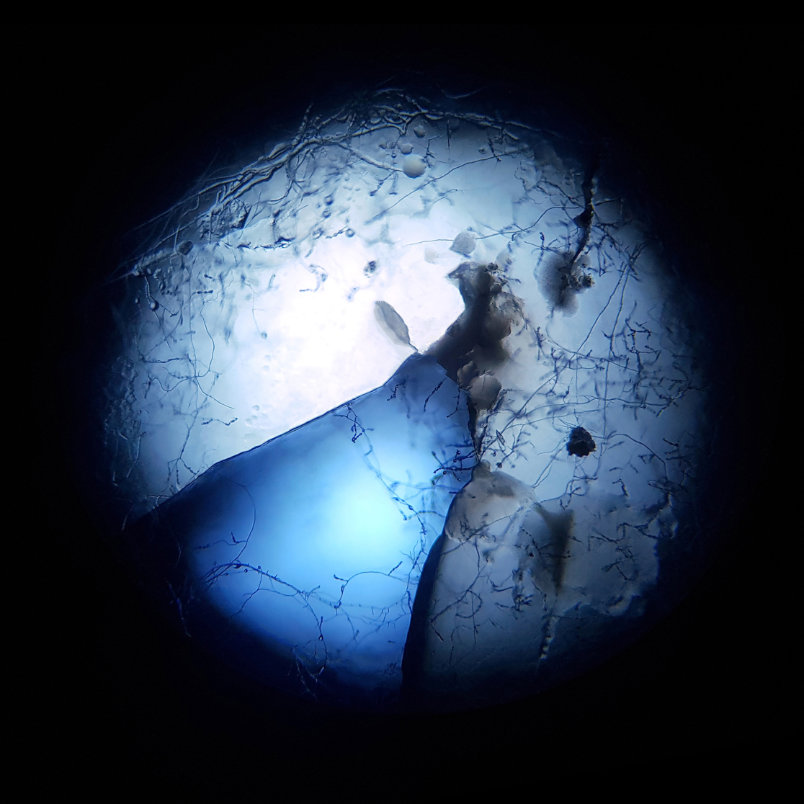
A disabled bio-philosophers helmet
Prejudice and ignorance contribute to undervaluing disabled peoples’ experiences, perpetuating discrimination and marginalisation.
Epistemological assumptions have historically marginalised disabled individuals by framing knowledge within a narrow lens that often excludes non-normative experiences. These assumptions prioritise conventional cognitive processes, disregarding the diverse ways disabled individuals know and engage with the world.
Medium
PTSD canine and human DNA cultured on agar
Image type
Digital C-Type print, flush-mounted on 3mm Alupanel
Dimensions
150 x 150 x 3 mm
Critical context
“A disabled bio-philosophers helmet’ challenges traditional notions of epistemology and highlights diverse ways of knowing, emphasizing the importance of lived experiences thus (re)shaping ableist assumptions of disability. Cripistemologies creates an additional knowledge space that validates and empowers the voices and contributions of people with disabilities into further shaping our understanding of the world."Historically, negative viewpoints on disability often stemmed from medical or social models that framed disability as a deficit or deviation from the norm. These perspectives perpetuated stigmas, discrimination, and marginalization. In contemporary philosophy, a shift towards more positive insights is evident. Disability studies, drawing from critical and intersectional perspectives, challenges ableism and embraces disability as a natural aspect of human diversity. Philosophical methods now emphasize empowerment, inclusivity, and the recognition of disabled individuals’ agency, contributing to a more positive and respectful understanding of disability.
Cripistemologies are frameworks of understanding rooted in critical disability studies. They prioritize disabled individuals’ experiences, challenging traditional knowledge paradigms. By valuing diverse ways of knowing, these epistemologies aim to dismantle ableist assumptions and create inclusive spaces. Cripistemologies empower disabled voices, recognizing their expertise in shaping a more comprehensive understanding of the world.
Dismissing disabled individuals’ knowledge often stems from ableism, societal stereotypes, and a lack of intellectual understanding. Prejudice and ignorance contribute to undervaluing disabled peoples’ experiences, perpetuating discrimination and marginalisation.
Epistemological assumptions have historically marginalised disabled individuals by framing knowledge within a narrow lens that often excludes non-normative experiences. These assumptions prioritise conventional cognitive processes, disregarding the diverse ways disabled individuals know and engage with the world.
Cripistemologies offers an alternative approach. Grounded in the disability experience, cripistemology academically validates the varied ways of knowing, acknowledging the richness of embodied, sensory, and non-normative cognitive processes, thereby challenging and reshaping established and accepted epistemological norms.
Main explorative points:
Centering Lived Experiences:
Embrace personal narratives and experiences of disability as legitimate forms of knowledge.
Critiquing Ableism:
Challenge ableist assumptions within philosophical discourse to foster a more inclusive understanding.
Diverse Ways of Knowing:
Value alternative perspectives and ways of knowing beyond traditional philosophical frameworks.
Empowerment of Disabled Voices:
Amplify disabled voices in academia, ensuring their contributions are acknowledged and integrated.
Intersectionality:
Recognise the intersecting identities of disabled individuals, incorporating a nuanced understanding that enriches philosophical discourse.
Citations:
Bradshaw, G. 2010. You see me, but do you hear me? The science and sensibility of trans-species dialogue. Feminism & Psychology, 20(3), 407-419. https://doi.org/10.1177/0959353510368285
Chandler, Eliza, Katie Aubrecht, Esther Ignagni, and Carla Rice. 2021. “Cripistemologies of Disability Arts and Culture: Reflections on the Cripping the Arts Symposium (Editors’ Introduction).” Studies in Social Justice 15 (2): 170-179. doi:https://doi.org/10.26522/ssj.v15i2.2429. https://www.proquest.com/scholarly-journals/cripistemologies-disability-arts-culture/docview/2538052982/se-2.
Dolmage, Jay Timothy. 2017. Academic Ableism: Disability and Higher Education. University of Michigan Press. http://www.jstor.org/stable/j.ctvr33d50.
Haraway, D. J. 2015. Anthropocene, Capitalocene, Plantationocene, Chthulucene: Making Kin. Environmental Humanities 1 May 2015; 6 (1): 159–165. doi: https://doi.org/10.1215/22011919-3615934
Haraway, D. 1997. A Cyborg Manifesto: Science, Technology, and Socialist-Feminism in the Late 20th Century. In: Weiss, J., Nolan, J., Hunsinger, J., Trifonas, P. (eds) The International Handbook of Virtual Learning Environments. Springer, Dordrecht. https://doi.org/10.1007/978-1-4020-3803-7_4
Haraway, Donna J. 2008. When Species Meet. Minneapolis: University of Minnesota Press.
Kent, M., Ellis, K., Garland-Thomson, R., & Robertson, R. (Eds.). 2018. Manifestos for the Future of Critical Disability Studies: Volume 1 (1st ed.). Routledge. https://www.taylorfrancis.com/books/edit/10.4324/9781351053341/manifestos-future-critical-disability-studies-mike-kent-katie-ellis-rosemarie-garland-thomson-rachel-robertson
Johnson, Lisa & Mcruer, Robert. 2014. Cripistemologies: Introduction. Journal of Literary & Cultural Disability Studies. 8. 127-147. https://muse.jhu.edu/article/548847/pdf
Nazzari, Anna; Cinanni, Gina; Doropoulos, Moira. 2014. Assessing the Image: Creative Practice in an Online Learning Environment. International Journal of the Image. Volume 4 Issue 2. https://web.p.ebscohost.com/ehost/pdfviewer/pdfviewer?vid=0&sid=f950a19e-e969-4c9b-9c0a-e298d4bc7b27%40redis
Nocella, Anthony J., Amber E. George, and J. L. Schatz. 2017. The intersectionality of critical animal, disability, and environmental studies: toward eco-ability, justice, and liberation. Rowman & Littlefield. US.
Reeve, Donna. 2012. Disability and Social Theory: New Developments and Directions. Cyborgs, Cripples and iCrip-reflections on the contribution of Haraway to Disability Studies., Palgrave Macmillan UK. ProQuest Ebook Central, https://ebookcentral.proquest.com/lib/curtin/detail.action?docID=931694.